What Customer Success Really Means (It’s More Than Support or Onboarding)
You can build the smartest product in the room — and still fail.
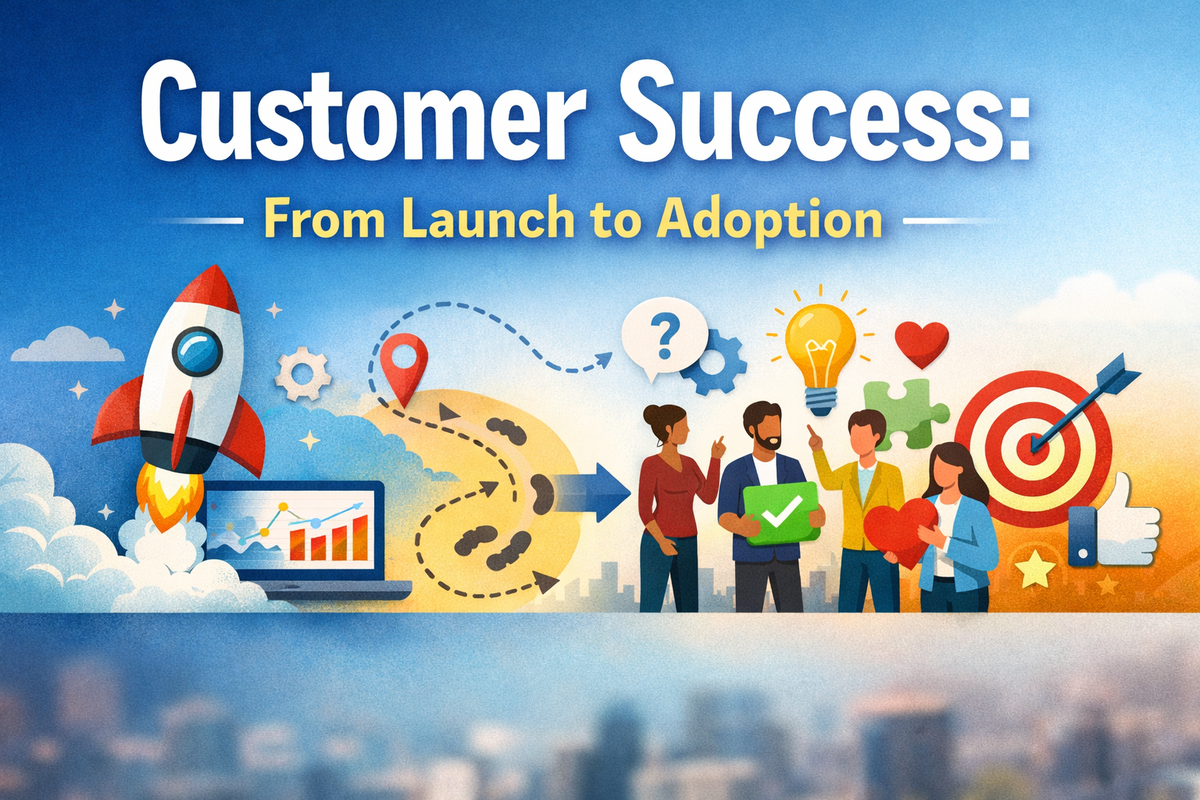
Customer Success is often misunderstood as training, support, or post-launch care. But true Customer Success reaches far deeper.
Customer Success is the intentional, ongoing process of ensuring your users achieve the outcomes your product promises.
It’s not about:
- Logging tickets
- Running walkthroughs
- Closing go-live checklists
It is about:
- Understanding real user workflows
- Guiding people through change
- Removing friction before it shows up
- Turning a product release into a product habit
- Ensuring users can use it easily, confidently, and repeatedly
In short…
Customer Success turns technology into value.
The Costly Myth: “If We Build It, They Will Use It.”
Stakeholders and teams often assume adoption is automatic. I have heard so many people say:
“We built the feature exactly as requested.”
“We followed the requirements.”
“This platform is clearly better than the old one.”
“They’ll adjust once they see how powerful it is.”
But humans don’t operate on logic alone.
They operate on trust, familiarity, relevance, and context.
A few common reasons products fail after launch:
1. Users were not involved early enough.
They saw the tool for the first time at training — far too late to influence it.
2. Leadership was aligned, but day-to-day users were not.
Executive sponsorship ≠ frontline adoption.
3. The product solves the business problem, but not the user’s workflow.
If it slows them down, they revert to the old way.
4. The team underestimated culture and behavior change.
People don’t abandon habits easily — even “bad” ones.
5. The team optimized for delivery, not value realization.
Going live became the finish line instead of the starting point.
A technically perfect product can still fail if people don’t connect with it, understand it, or believe it helps them.
Adoption Comes From Involvement — Not Announcements
If you want a product that launches successfully and stays relevant, you need users who feel ownership long before go-live.
Here’s what that looks like in practice:
1️⃣ Involve Your Customers Early
Invite them into the process while assumptions are still flexible.
Early feedback saves enormous rework later.
What you learn in week 2 is always cheaper than what you discover in week 22.
2️⃣ Let Them Play with the Product
Hands-on time beats any slide deck.
When users can touch the product:
- they gain familiarity
- they build confidence
- they reveal hidden friction points you could never predict
3️⃣ Encourage Critique — Not Praise
Criticism is a gift.
It exposes what your team can’t see.
Let users:
- point out what feels clunky
- highlight where the workflow doesn’t make sense
- explain what slows them down or confuses them
Their frustration becomes your roadmap.
4️⃣ Give Them a Role in Shaping It
Once users see their fingerprints on the solution, they shift from accepting to championing the product.
Ownership beats compliance — every single time.
5️⃣ Build a Change Story, Not Just a Launch Plan
Users need to know:
- why the change matters
- how it helps them
- what will be different
- what support exists
- how success will be measured
Change doesn’t fail because technology isn’t ready.
Change fails because people weren’t prepared.
Iteration Builds Trust — Trust Builds Adoption
User feedback should never end at go-live.
Every improvement communicates:
💬 “We’re listening.”
💬 “Your experience matters.”
💬 “We will keep making this better with you.”
This is how teams turn:
- skepticism into partnership
- resistance into collaboration
- uncertainty into confidence
And confidence is what drives sustainable adoption.
The Bottom Line: Your Product’s Success Lives or Dies by Adoption
A product doesn’t succeed when it’s released.
A product succeeds when people use it, rely on it, and experience real value from it.
Customer Success is the engine that makes this happen.
If you want:
- higher adoption
- fewer failed launches
- stronger stakeholder trust
- product longevity
- measurable impact
…you need Customer Success built into the delivery lifecycle — not bolted on at the end.
Because in the real world:
👉 Value isn’t created by what you build.
Value is created by what customers adopt.