The Delivery Director’s Playbook: Turning Vision into Reliable Execution
Discover how Delivery Directors can turn strategy into motion. Inspired by Newton’s Cradle, here are shared lessons on transferring vision into reliable execution through balance, rhythm, and continuous energy flow.
In every transformation, there’s a moment that separates good delivery from great delivery.
It’s the moment when the vision feels clear, but the execution begins to waver.
I have once led one transformation where everything looked aligned — the roadmap, the teams, the executive buy-in — until it wasn’t.
Progress stalled.
Momentum faded.
And everyone began to question whether the vision was ever realistic.
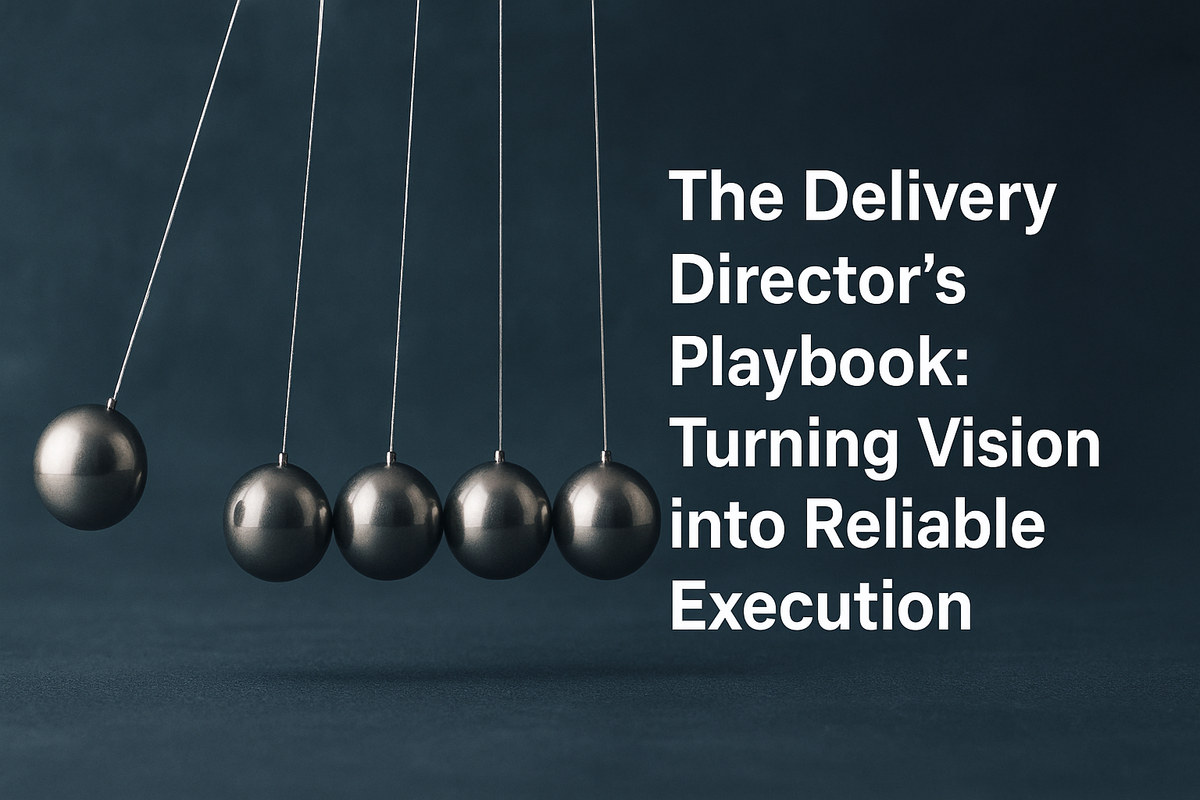
That’s when a small, silver object on my desk caught my eye: Newton’s Cradle — five steel spheres transferring energy from one end to another in perfect balance.
And it hit me: this is what delivery leadership should look like.
Lesson 1: The Vision Is the First Ball
In Newton’s Cradle, when the first ball swings, it transfers energy through the others — even though they barely move.
That’s your strategy.
It should ignite motion without chaos.
Too often, organizations swing hard with bold visions but lose momentum before it reaches the team.
Why? Because the energy dissipates in translation — between strategy and execution.
The role of a Delivery Director/Manager/Lead is to preserve that energy — to ensure the intent, focus, and urgency of the vision passes cleanly through every layer of delivery.
Lesson 2: Every Layer Matters
In the cradle, if one ball is misaligned, the motion stops.
In delivery, if one team, portfolio, or product stream misfires, momentum stalls.
During that transformation, we discovered that our middle layer — the layer translating strategy into work — was overloaded with approvals and bureaucracy, not outcomes.
Once we restructured around value streams instead of projects, the “motion” came back.
Energy moved cleanly.
Teams started making decisions in days, not weeks.
Lesson 3: Balance Energy and Control
The secret to Newton’s Cradle isn’t speed — it’s equilibrium.
Delivery leadership isn’t about pushing harder; it’s about synchronizing intent.
I learned that every transformation needs these three forces in balance:
Vision energy — the drive from leadership to inspire movement.
Operational rhythm — the discipline to sustain motion without burnout.
Feedback velocity — the data loops that show when energy is being lost.
When these forces align, execution becomes reliable, not reactive.
The Delivery Director’s Playbook
Every delivery leader needs three practices to turn strategy into momentum:
- Translate, don’t transmit. Don’t just pass strategy down — contextualize it for each layer.
- Measure energy flow. Track where intent fades — in governance, culture, or communication.
- Maintain rhythm. Governance should enable flow, not block it.
It’s not about pushing people harder — it’s about designing motion that lasts.
Reflection
When vision and execution align perfectly, your organization behaves like Newton’s Cradle — one pulse of clarity creates a chain of motion, perfectly synchronized from strategy to delivery.
The future of delivery leadership is not about managing activity; it’s about mastering energy transfer.
Ask yourself:
“Where does energy stall in our organization — and what would it take to restore flow?”
If this resonates, follow my ongoing series — The Future of Delivery Leadership — where I share frameworks, real-world lessons, and reflections on bridging strategy, delivery, and transformation.
Connect with me on LinkedIn or explore more insights like: