The Future of Delivery Leadership — Issue #1
PMOs were built for control, not agility. Explore how the Value Management Office (VMO) is redefining delivery leadership — linking strategy, funding, and outcomes to drive modern enterprise transformation.
Why Traditional PMOs Are Dying — and What’s Replacing Them
For decades, the Project Management Office (PMO) was the heartbeat of organizational delivery — the engine that brought order to chaos, ensured governance, and safeguarded budgets.
But somewhere along the way, that engine started stalling.
Across industries, I’ve watched and been part of brilliant delivery teams stuck in endless cycles of tracking, reporting, and compliance — while strategic outcomes quietly slip away.
Executives ask, “Why isn’t our transformation moving faster?”
And the uncomfortable answer is: because our delivery structures were designed for a world that no longer exists.
The PMO Death Spiral
Traditional PMOs were built for predictability. They thrived in a time when strategies were stable, projects were linear, and outcomes could be neatly measured against baselines.
But today’s business landscape is different:
- Strategy shifts every quarter.
- Teams are organized around products, not projects.
- Value emerges through iteration, not control.
Yet, many PMOs are still measuring success through the lens of timelines, scope, and budget adherence.
It’s like trying to measure the wind with a ruler.
The result? Delivery teams optimize for compliance, not creativity.
And organizations lose their most valuable advantage — speed of learning.
What’s Replacing the PMO
The most forward-thinking organizations aren’t trying to “fix” the PMO.
They’re reimagining it.
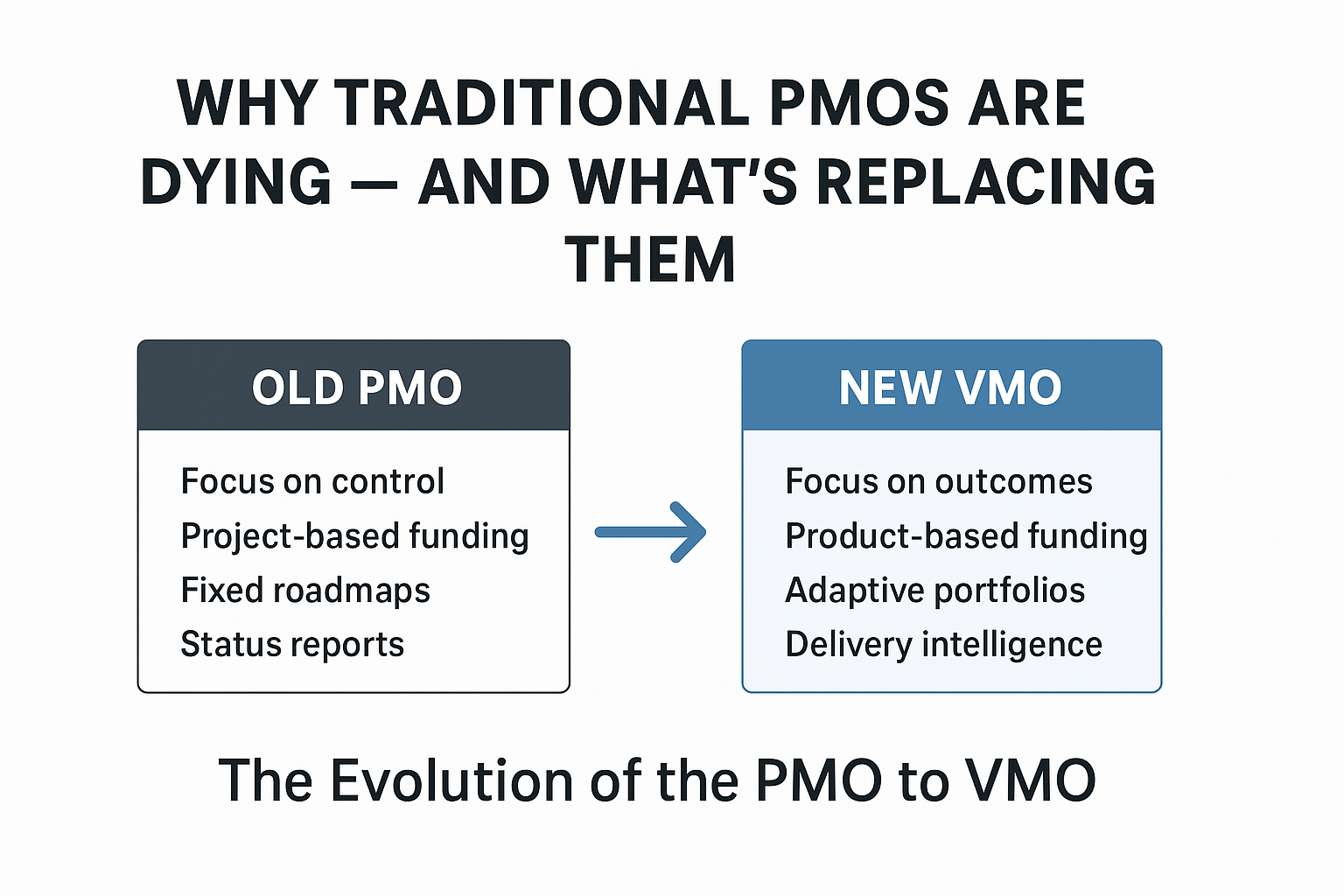
They’re building Value Management Offices (VMOs) — agile, insight-driven structures that link strategy, funding, and delivery through continuous value measurement.
Here’s what the shift looks like in practice:
| Old PMO | New VMO |
|---|---|
| Focus on control | Focus on outcomes |
| Project-based funding | Product-based funding |
| Fixed annual roadmaps | Adaptive portfolios |
| Status reports | Delivery intelligence |
| Governance by compliance | Governance by data and learning |
The Value Management Office isn’t anti-governance — it’s pro-impact.
It ensures that delivery leadership is about guiding value, not policing work.
It doesn’t just track what’s being done. It asks the more important question:
“Is what we’re delivering still driving the strategy forward?”
The Delivery Leader’s Playbook for 2026
As we step deeper into this new era of delivery leadership, here are three reflection questions to guide your transformation:
- Are our delivery structures built for control or for learning?
- Do we fund activities or outcomes?
- Are our leaders asking for progress or value?
The delivery leaders of the future aren’t project managers — they’re strategic orchestrators.
They connect vision with value, teams with purpose, and data with decisions.
In this world, governance isn’t about slowing things down — it’s about enabling the right outcomes faster.
Practical Takeaway
- Rethink your PMO charter — move from process ownership to value enablement.
- Establish continuous alignment between strategic intent and delivery outcomes.
- Measure success through business impact, not activity completion.
This shift isn’t about killing the PMO. It’s about evolving it.
The organizations that make this transition first will lead not just in delivery — but in strategy execution maturity.
Ask yourself:
What would a “Value Management Office” look like in your organization?
I’m exploring this topic in depth in my upcoming article,
“From PMO to VMO: The Blueprint for Modern Strategy Execution.”
Follow this series — The Future of Delivery Leadership — for monthly insights on how organizations are connecting strategy, delivery, and transformation in the modern enterprise.
Connect with me on LinkedIn to continue the conversation.