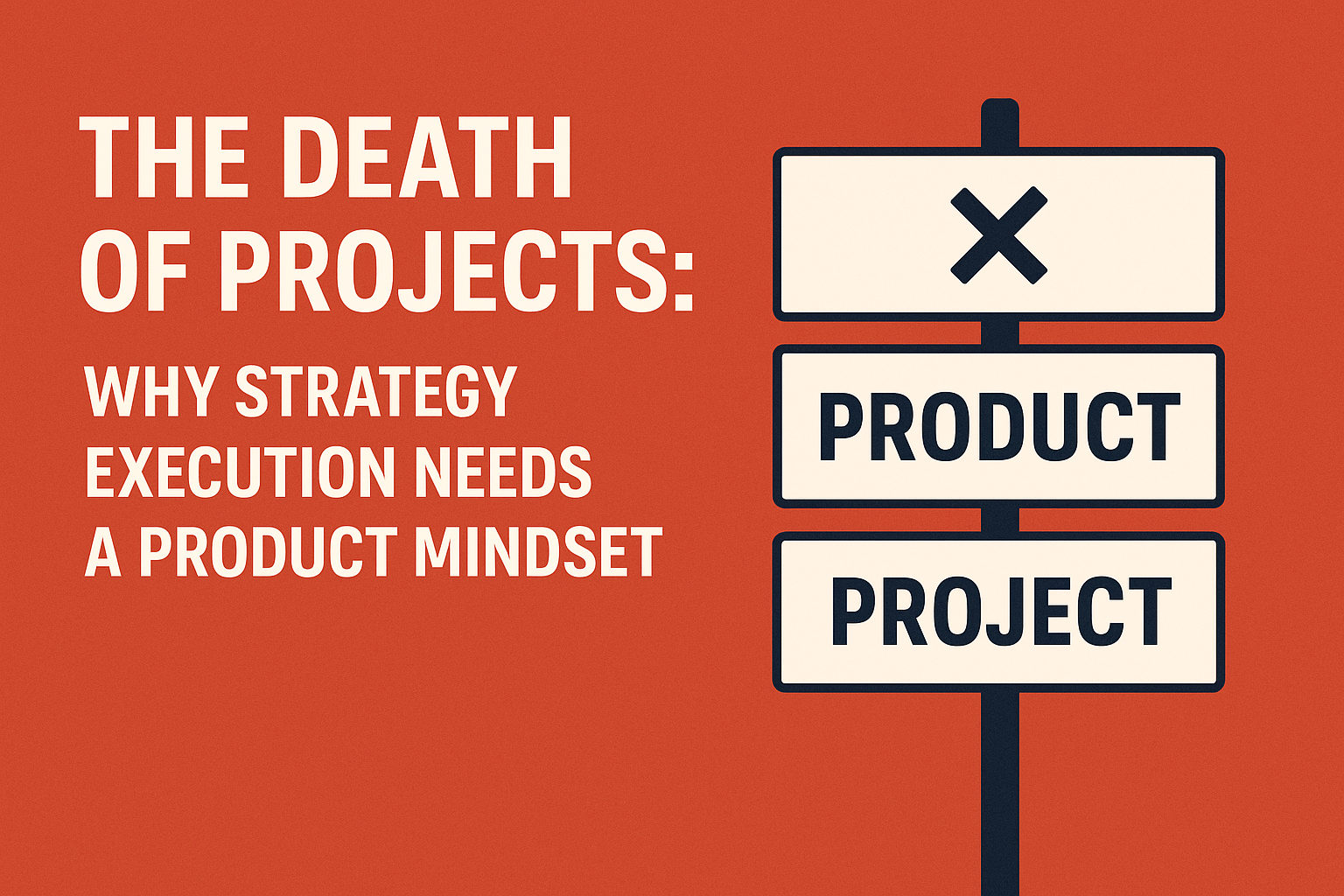
The Death of Projects: Why Strategy Execution Needs a Product Mindset
Projects chase deadlines — products deliver outcomes. Discover why the future of strategy execution demands a product mindset and how organizations can shift from control to continuous value creation.
A few years ago, I was leading a major enterprise transformation — one of those multi-million-dollar initiatives with every acronym attached: PMO, Agile, OKRs, VPs, and SLAs.
We had a clear strategy. A well-documented roadmap. Dozens of projects were running in parallel.
And yet — nothing felt connected.
Teams were busy but not aligned. Stakeholders requested updates, but not outcomes. Every meeting was about deliverables, not value.
One afternoon, after yet another review where we discussed timelines instead of impact, one of my stakeholders asked me the question that changed everything:
“If all these projects succeed… will our strategy actually move forward?”
That question exposed the truth: The organization excelled at managing projects, but struggled with delivering strategy.
The Project Mindset Trap
Traditional project management is designed for certainty and control — start, finish, deliver, close. But strategy execution in today’s environment demands adaptability and evolution — sense, respond, learn, iterate.
Here’s what I have seen repeatedly across enterprises:
- Teams measured success by milestones, not outcomes.
- Leaders optimized for outputs, not impact.
- Roadmaps became rigid contracts instead of living hypotheses.
- “Completion” was celebrated — even if customer value never arrived.
In short, projects delivered deliverables, but not strategic change.
From Projects to Products
When we reframed our delivery approach around products instead of projects, everything changed.
Products became the unit of value, not activities. Roadmaps became value hypotheses, not Gantt charts or Miro boards. And delivery became a continuous learning loop, not a one-time execution cycle.
The team started asking:
- Who is this for?
- What outcome are we driving?
- How will we measure success over time?
This single mindset shift — from “deliver the project” to “evolve the product” — created alignment, focus, and accountability we’d never seen before.
Our strategy stopped living in decks/boards and started living in customer experiences.
Three Lenses for a Product Mindset in Strategy Execution
To make this shift scalable, I introduced three guiding lenses:
1. Outcome Over Output
Define success in terms of measurable outcomes — not task completion. Ask: “What’s the change we’re enabling?” before “What’s the plan we’re executing?”
2. Continuity Over Closure
Think in continuous value cycles, not start-stop initiatives. Projects end. Products evolve. Strategies live.
3. Empowerment Over Control
Equip teams with ownership of outcomes, not compliance to plans. When teams own why, they’ll figure out how.
Strategy That Actually Moves
After adopting this product mindset, our transformation metrics shifted dramatically:
- Cycle time dropped by 30%
- Value realization increased by 2.4x within 10 months
- Engagement scores within delivery teams improved by 40%
More importantly, executives stopped asking “Is the project on track?” They started asking, “Are we moving the needle?”
That’s when I knew the project mindset had truly died
This isn’t about discrediting project management. It’s about elevating its purpose. Projects still matter — but they’re no longer the end. They’re the means through which products deliver ongoing strategic value.
The future of delivery leadership isn’t defined by managing work — it’s defined by connecting strategy to sustained outcomes.
If you’re leading transformation or struggling to connect strategy to delivery impact, it’s time to evolve how your organization defines success.
Let’s start the conversation:
What would “product mindset” look like in your strategy execution model?
Which parts of your organization are still celebrating delivery instead of outcomes?
Share your thoughts below — I’m curating a series on “The Future of Delivery Leadership” and would love to include real-world insights from leaders driving this change.
🔗 Follow me on LinkedIn or subscribe to my Website for more frameworks, reflections, and field-tested lessons on transforming delivery into strategy in action.